
AI activity intelligence
Understand what your organization is actually doing with AI.
Knowing which AI tools exist is only the first step. Vayon AI connects observed AI activity to business meaning — helping the organization understand which use cases are active, how they are actually being used and where observed behavior differs from what was declared.
From activity evidence to organizational understanding
A factual activity layer before interpretation
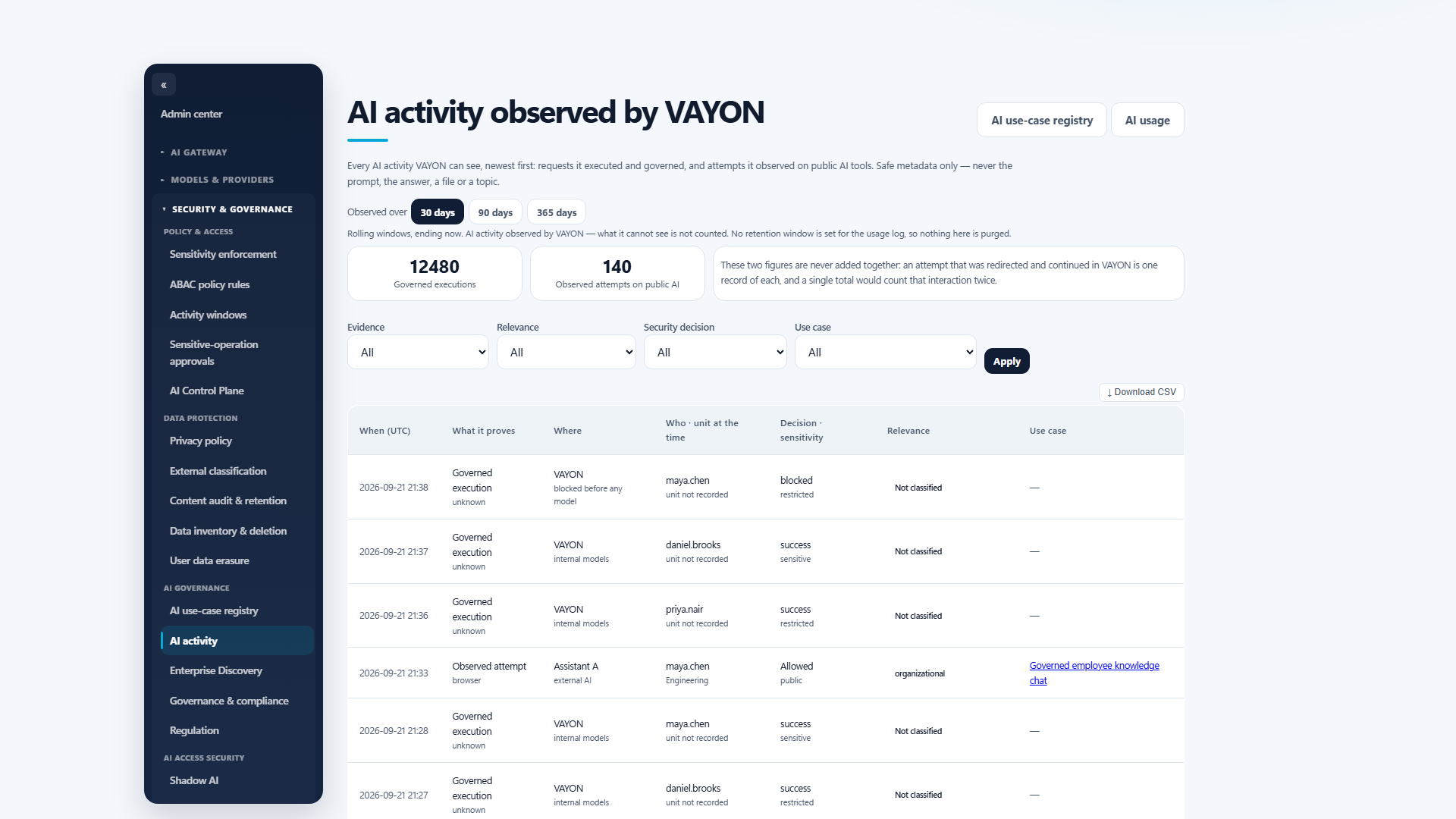
Vayon AI brings together safe activity evidence from governed execution and from supported external observation, keeping the provenance of each. The activity layer preserves what was observed and where it came from, without turning every event into a business conclusion.
Recurring activity becomes a governed business use case
Business use cases can be declared, linked to governed systems and agents, and supported by observed evidence. Where repeated organizational activity suggests a new use case, Vayon AI raises it as a draft proposal for human review — never an approved use case — and both the threshold and the discovery switch stay under administrator control.
See the difference between intent and reality
Declared purpose and observed activity are kept separate, and one is never written back over the other. That makes it possible to identify activity while a use case is inactive, external activity that was not declared, observed risk higher than the declared posture, or a use case declared and never observed at all.
Organizational AI usage as a map, not a spreadsheet
The AI Usage Map connects organizational units, use cases, channels and bound sources through the same canonical read model as the registry. Observed relationships, configured-but-not-observed relationships and activity Vayon AI cannot observe stay distinct — and activity that is not a use case yet is shown as exactly that.
Understanding without turning governance into surveillance
Vayon AI is designed around bounded governance evidence: activity carries stable classification codes and the destination host, not prompts, responses or attachments. Unit-level breakdowns are withheld below a small-group threshold, so adoption can be understood without reporting on an individual.
How the map reads
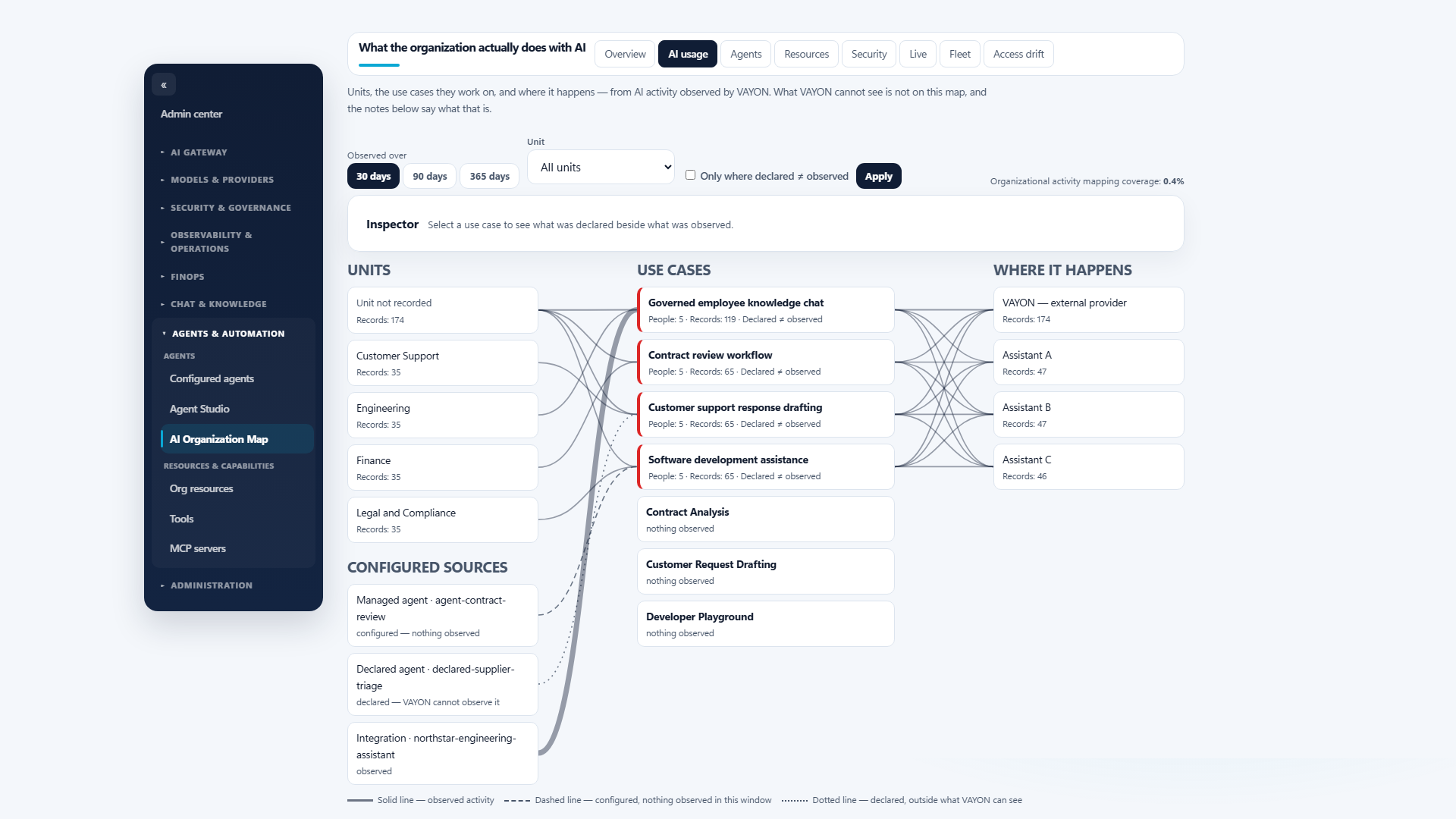
Unit → Use case → Channel → Source
Observed
Evidence of real activity on this relationship.
Configured
A governed relationship that exists in configuration but has not been observed.
Declared / not directly observable
Declared by the organization, including relationships Vayon AI cannot directly observe.
The three states above are an explanatory key to the line styles in the map.
Frequently asked questions
Does this store prompts and responses?
No. Activity evidence carries stable classification codes and the destination host — not prompts, responses or attachment content. Content audit is a separate capability under explicit policy; organizational understanding does not depend on it.
Is activity attributed to named people?
Only where identity is proven. A device-scoped request stays unattributed rather than being given a person's name, and unit-level breakdowns are withheld below a small-group threshold.
Are governed and observed activity combined into one number?
No. Governed execution and external observation answer different questions and keep separate provenance. An observed browser event is a submission attempt, not proof that an AI service answered, so the two are reported side by side rather than summed.