
See the AI your organization is already using
Vayon AI builds an organization-wide view of AI usage from the security and IT systems you already operate. Connect existing SIEM, CASB, EDR, MDM and IAM telemetry — and other network- or API-based sources — to identify AI services, users, departments, usage patterns and risk, without deploying another endpoint agent.
Govern. Route. Audit.
The AI you cannot see
Employees adopt public AI assistants. Developers connect coding tools directly to model providers. Business applications embed their own AI integrations. Each path creates its own identities, accounts, costs and risk — outside any inventory your security or IT team maintains today.
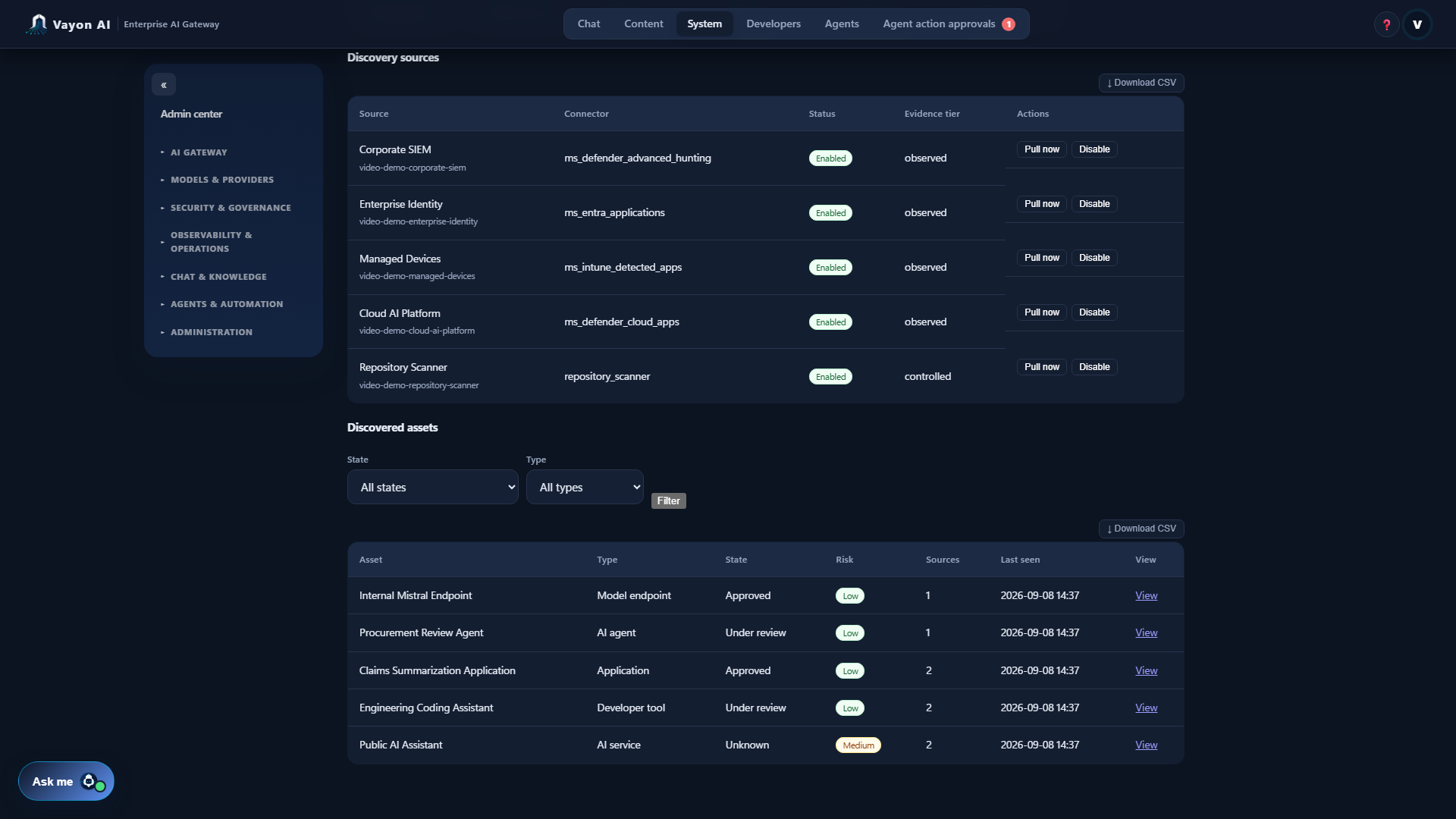
Reading what your systems already record
Vayon AI does not require a new endpoint agent to build this picture. It draws on telemetry already produced by the security and identity systems your organization operates, and correlates it into a single organizational view of AI usage.
The sources you already run
Vayon AI reads from the enterprise systems most organizations already operate, over their own APIs. Supported discovery sources include Splunk, Elastic, Microsoft Defender Advanced Hunting, Microsoft Defender for Cloud Apps, Intune, Entra applications, SARIF and CI evidence, AI-BOM inventories, and generic SIEM or REST telemetry through a configurable connector. Which sources are available in a given deployment depends on what the organization configures and licenses:
- SIEM — security event and log data that reveals access to AI services and model endpoints.
- CASB — cloud access security broker data on sanctioned and unsanctioned AI application use.
- EDR — endpoint detection and response signals on AI-related processes, files and network activity.
- MDM — mobile/device management inventories of installed applications.
- IAM — identity and access data on OAuth application consents and delegated permissions.
- Other network- and API-based telemetry, including SASE and similar sources, through a configurable connector.
From raw telemetry to a named AI service
Observations from every connected source are normalized into one consistent model, then correlated so the same underlying AI service — seen from a firewall log, an identity system and an endpoint signal — is recognized as one entry, not three.
Attribution preserved where the source can prove it
Where a connected source provides trustworthy identity or ownership evidence, Vayon AI can associate an observation with a user, device, application or organizational owner, so ownership is not a separate investigation. Where the source does not prove attribution, the activity stays unattributed rather than being given an owner it cannot support.
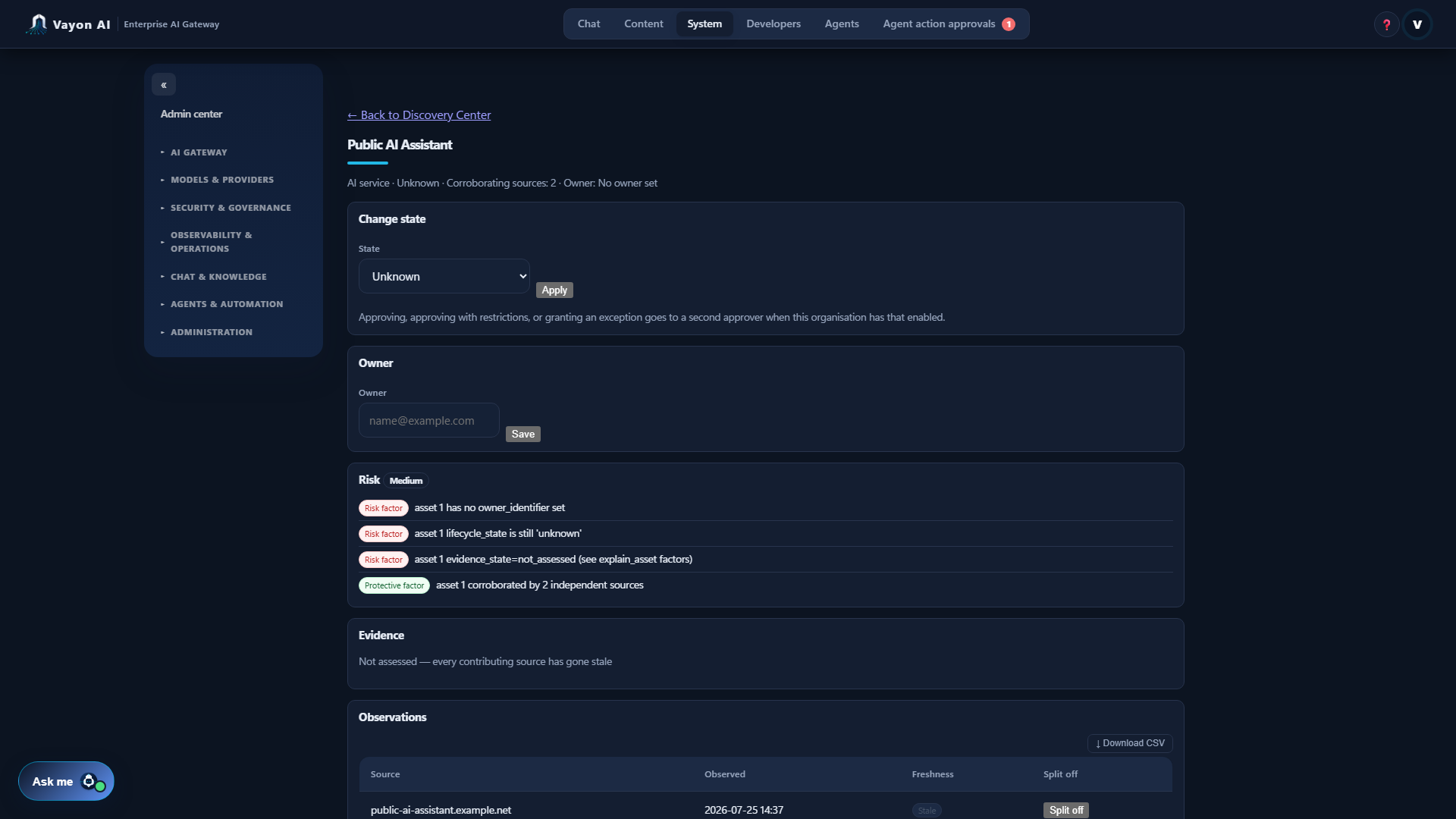
Prioritized by risk, not by alert volume
Discovered services and activity are scored so ordinary, low-risk use is distinguished from patterns that are sensitive, unusual or relevant to policy — the review queue stays a short list, not a flood.
From visibility to governed access
Discovery does not silently promote an uncertain observation into an approved organizational asset. A reviewed, approved AI service moves into Vayon's governed access surfaces and Gateway, under the same identity, policy and audit model as every other request.
From visibility to understanding
Discovery tells you where AI is being used. Activity Intelligence helps explain what the organization is using it for — connecting observed activity to business use cases, and showing where observed behavior differs from what was declared.
Two complementary channels, one picture
Everything above is built from telemetry your existing systems already produce, with no Vayon AI endpoint agent required for that path. Managed browser extensions add the second channel: a complementary real-time governance path for web-based AI use across Chrome, Edge and Firefox, applying organizational preflight decisions before content is sent to a supported AI destination. The two answer different parts of the same question, and Vayon AI keeps their provenance distinct rather than blending them — what is governed, what is merely observed, and what still needs review. Vayon AI discovers, correlates, attributes where the evidence allows and reports; it is not a firewall, a CASB or a secure web gateway, and actual network blocking may remain with the enforcement points you already run.
Find out what is already running
Discovery reads the systems you already operate. The first picture usually takes people by surprise.